
Category: RSU

  • RSU Cost Basis and 1099-B Explained (Avoid Double Taxation)

    RSU Cost Basis and 1099-B Explained (Avoid Double Taxation)

    Selling RSU shares is not the end of the tax story. How your cost basis is reported can result in paying taxes on income that was already taxed at vesting. Here is what to look for and how to protect yourself.


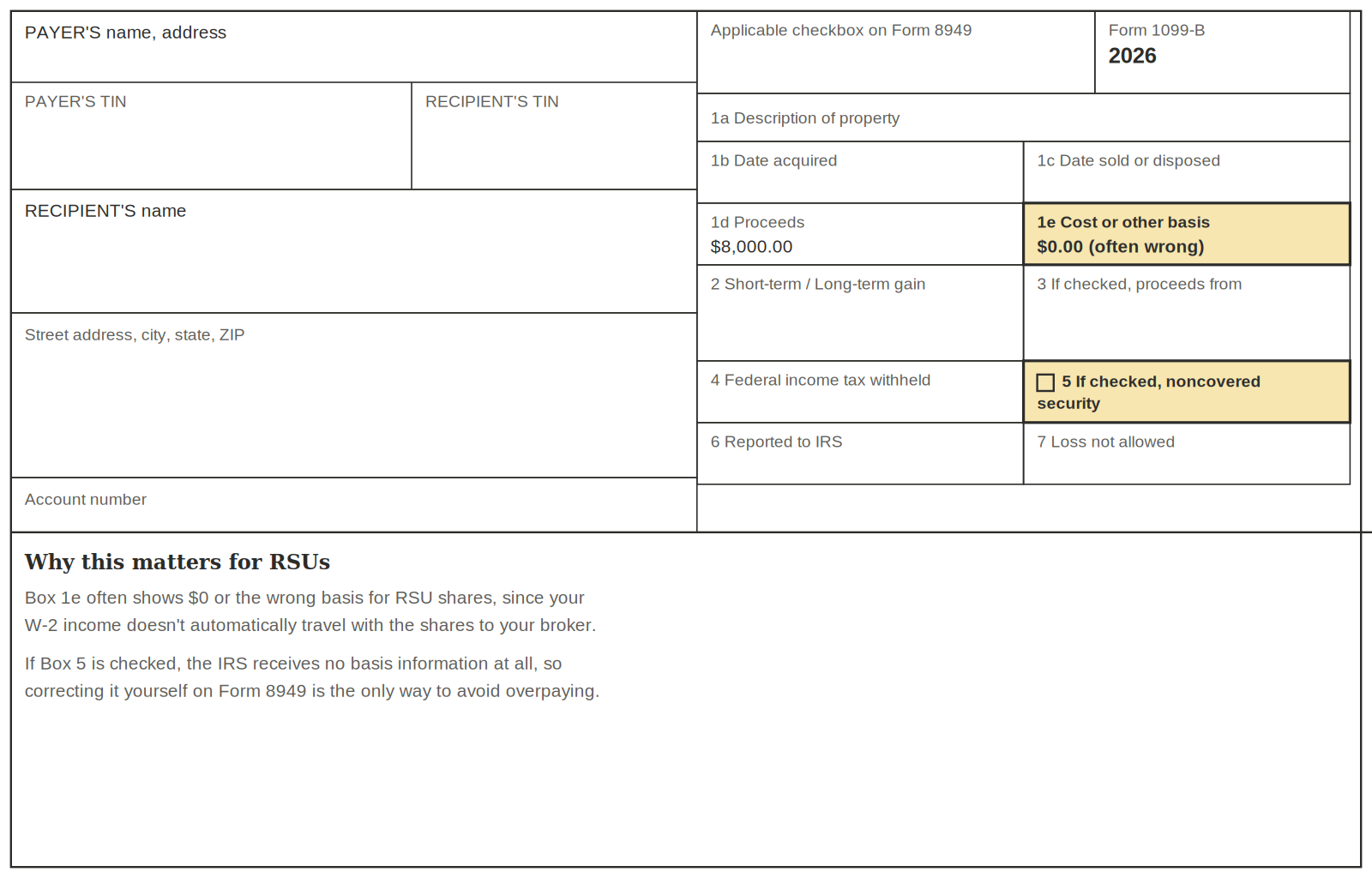
      When you sell RSU shares, your broker sends you a 1099-B reporting the proceeds. What that form shows for your cost basis determines how much of your gain is subject to capital gains tax. The problem is that brokers frequently report an incomplete cost basis for RSU shares, which can make it look like your entire sale proceeds are taxable as a gain, even though a significant portion was already taxed as ordinary income when the shares vested. This is one of the most overlooked and consequential tax issues in equity compensation planning for women in tech, and it is entirely avoidable with the right records and a clear understanding of how cost basis works for RSUs.

    What Cost Basis Means for RSUs

    Cost basis is the starting value used to calculate your gain or loss when you sell an asset. For most investments, your cost basis is what you paid for the asset. RSUs are different because you did not pay anything for the shares. They were granted to you as compensation and delivered at vesting. For RSU shares, your cost basis is the fair market value of the shares on the date they vested. This is the same value that was treated as ordinary income on that date and included in your W-2. You have already paid income tax on that amount. It is not taxable again. When you sell the shares, only the difference between your sale price and your cost basis is subject to capital gains tax. If you sell for more than the vest-date value, you have a gain. If you sell for less, you have a loss.

    💡 Key Concept

    Your cost basis for RSU shares is the fair market value on the vest date, not zero. Using zero as your cost basis would mean paying capital gains tax on income that was already taxed as ordinary income at vesting. The two events are separate and should be reported separately.

    Why the 1099-B Can Understate Your Cost Basis

    Brokers are required to report cost basis information on the 1099-B they send you after a sale. For RSU shares, however, the rules around what brokers are required to include have historically created gaps. For shares that vested before a certain date, brokers were not required to report cost basis information to the IRS at all, only the gross proceeds. For more recently vested shares, brokers may report a cost basis, but they may report only what was paid for the shares, which for RSUs is zero, rather than the fair market value at vesting that should serve as your actual cost basis. The result is a 1099-B that shows your full sale proceeds with an incomplete cost basis. If you simply enter that information as reported without adjustment, your tax software or preparer will calculate a capital gain on the full proceeds, even though a large portion of that amount was already reported as income on your W-2 and taxed accordingly. This is not an error that the IRS will automatically correct. It is a reporting limitation that puts the responsibility on you to report the correct cost basis and explain any adjustments on your return.

    Short-Term vs. Long-Term Capital Gains on RSU Shares

    Once you understand that your cost basis is the vest-date fair market value, the next question is how any additional gain above that value is taxed. The answer depends on how long you held the shares after vesting. Shares sold within one year of the vest date produce a short-term capital gain on any appreciation. Short-term gains are taxed at ordinary income rates, the same rates that apply to your salary. Shares held for more than one year after the vest date produce a long-term capital gain on any appreciation. Long-term capital gains rates are generally lower than ordinary income rates for most taxpayers, though the specific difference depends on your income level and tax situation. The holding period clock starts on the vest date, not the original grant date. This is an important distinction. A grant made several years ago does not mean the shares automatically qualify for long-term treatment. Each tranche of shares starts its own holding period clock on the date those specific shares vested.

    📋 Planning Note

    If you are considering holding RSU shares for potential long-term capital gains treatment, the relevant date is your vest date, not your grant date. Understanding which vest tranches have crossed the one-year threshold at any point in time is worth tracking if holding shares is part of your strategy.

    How to Report RSU Sales Correctly

    When you sell RSU shares and receive a 1099-B with an incorrect or incomplete cost basis, you will need to adjust the reported cost basis on your tax return. This typically involves reporting the sale on Schedule D and Form 8949, entering the proceeds as shown on the 1099-B, and then adjusting the cost basis to reflect the correct vest-date fair market value. To make this adjustment accurately, you need records of your vest events, specifically the dates shares vested and the fair market value of the stock on each of those dates. Most equity platforms such as Fidelity, Morgan Stanley, Schwab, and Carta maintain this information in your account history. Your W-2 should also reflect the total RSU income reported for the year, which can serve as a cross-check. If you used a share-withholding method to cover taxes at vest, a portion of your shares was sold at vesting to cover tax obligations. These transactions are typically reported on a 1099-B as well. Because the sale usually occurs at or near the vesting price, the resulting gain or loss is often minimal, but the transaction still needs to be reported.

    Keeping Records That Protect You

    The foundation of reporting RSU sales correctly is having clear records of each vest event. For every vest, it is worth documenting the vest date, the number of shares that vested, and the fair market value per share on that date. Your brokerage or equity platform typically stores this information, but having your own records is a useful backup, particularly if you change brokers or if records are difficult to retrieve years later. If you have had RSU vests across multiple years and have not been tracking this, it is worth reconstructing the record now while the information is still accessible. Your W-2s from prior years and your equity platform transaction history are the primary sources.

    ⚠️ Things to Watch Out For

    • Do not rely on the cost basis reported on your 1099-B for RSU shares without verifying that it reflects the fair market value at vesting. If the basis is understated or missing, correcting it can materially reduce your tax liability.
    • If you sold RSU shares in prior years and did not adjust the cost basis, it may be worth revisiting those returns. In some cases, an amended return may be appropriate.
    • Each vesting tranche has its own cost basis and holding period. If you sell shares from multiple vest dates in a single transaction, each tranche must be tracked and reported separately.
    • Shares sold to cover taxes at vest (share withholding) are also reportable transactions. While any gain or loss is typically minimal, these sales still need to be included on your return.
    • Tax software does not automatically adjust cost basis for RSU compensation. It will default to the information reported on the 1099-B unless you review and correct it.

    🌿 The Valoria Perspective

    Cost basis errors on RSU sales are common, consequential, and entirely fixable with the right information. The income tax at vesting and the capital gains tax at sale are two separate events that need to be treated separately. Keeping clear records of your vest history is one of the simplest things you can do to make sure you are only paying what you actually owe.


    Not sure what to do with your RSUs?

    I help women in tech build a clear, confident plan around their equity compensation.

    Schedule a Call

    M
    Maria Castillo Dominguez, CFP®, EA Founder of Valoria Wealth Management. Maria specializes in financial planning for high-earning women in tech with equity compensation, with a focus on building long-term wealth, optimizing their tax situation, and creating more financial freedom in their lives.

    This content is for informational and educational purposes only and is not intended as individualized financial, investment, or tax advice. Past performance is not indicative of future results. Any opinions expressed are as of the date of publication and may change. Please consult your financial advisor or tax professional regarding your specific situation before making financial decisions.

  • The RSU Tax Bill Nobody Warned You About

    The RSU Tax Bill Nobody Warned You About

    Your employer withholds taxes when your RSUs vest. For many high earners in tech, that withholding is not enough. Understanding why the gap exists and how to get ahead of it is one of the most practical things you can do for your finances.


      Tax season catches a lot of women in tech off guard. Not because they did anything wrong, but because the way RSU income is withheld does not always match the amount actually owed. The result is a balance due at filing, sometimes a significant one, and in some cases an underpayment penalty on top of it. This post explains how RSU tax withholding works, why it commonly falls short for high earners, what factors determine your actual tax liability at vest, and what you can do to get ahead of it before your next vest date.

    RSUs Are Taxed as Ordinary Income at Vesting

    When your RSUs vest, the value of the shares on that date is treated as ordinary income by the IRS. It is added to your taxable income for that year exactly the same way your salary is, and it is subject to federal income tax, state income tax where applicable, Social Security tax, and Medicare tax. This happens whether you sell the shares immediately or hold them. The taxable event is the vest date, not the sale date. If you hold the shares and the price drops the following week, you already owe tax on the value they had when they vested.

    💡 Key Concept

    Vesting is the first taxable event. Holding your shares after they vest does not defer or reduce your income tax obligation for that vest. It only determines whether you also owe capital gains tax later, based on what happens to the price after the vest date.

    How Employers Withhold RSU Taxes

    Most employers withhold taxes at vest using one of two methods: share withholding, where a portion of your vesting shares is sold automatically to cover taxes, or cash withholding from a payroll account. In either case, the employer is required to remit taxes on your behalf at the time of vesting. The amount withheld is typically based on the federal supplemental wage withholding rate. For most RSU income, this is currently 22%, regardless of your actual marginal tax bracket. Once total supplemental wages exceed a certain threshold in a calendar year, a higher rate may apply. Your state may also have its own supplemental withholding rate that your employer uses. The important thing to understand is that supplemental withholding rates are flat rates applied uniformly. They are not calculated based on your individual tax situation, your total income for the year, your filing status, or any deductions you may have. They are a starting point, and for many high earners, they are not the ending point.

    Why the Withholding Gap Exists

    For employees whose total income puts them in a higher federal tax bracket than the supplemental withholding rate, there will be a gap between what was withheld and what is actually owed. This gap does not disappear. It shows up as a balance due when you file your return. Several factors can widen this gap meaningfully. A high base salary means your RSU income layers on top of earnings that are already pushing you into higher brackets. A large vest event in a single calendar year can result in a substantial amount of income being recognized at once. If you have multiple vests across the year, the cumulative effect can be significant. And if you live or work in a high-tax state, state income tax adds another layer that supplemental withholding may not fully cover. None of this is a penalty or an error. It is simply how the system works when flat withholding rates are applied to income that varies widely in size and timing across taxpayers. The responsibility to address any gap falls on you, not your employer.

    📋 Planning Note

    If you received a large tax bill last April and had significant RSU vests during the year, the withholding gap is likely what happened. The fix is not complicated, but it does require being proactive rather than reactive. Waiting until filing season to discover the gap means the money may already be spent.

    Estimated Tax Payments

    One of the most effective ways to address the withholding gap is through estimated tax payments. The IRS requires taxpayers to pay taxes as income is earned throughout the year, not just at filing. If your withholding does not cover enough of your tax liability, you may be required to make quarterly estimated payments to make up the difference. Estimated payments are made directly to the IRS, and to your state tax authority if applicable, on a quarterly schedule. The due dates fall in April, June, September, and January of the following year. Missing these payments or underpaying them can result in an underpayment penalty, which is separate from the tax itself. Whether estimated payments make sense for your situation depends on your total income, your existing withholding from salary, and the size and timing of your vest events. A financial planner or CPA can help you calculate whether you are on track or whether adjustments are needed.

    Adjusting Your W-4 Withholding

    Another option for addressing the gap is to adjust your W-4 with your employer to withhold additional federal income tax from each paycheck. This does not change the withholding on your RSU income directly, but it increases the total amount withheld from your compensation across the year, which can offset the shortfall from RSU vests. This approach works well when your vest events are relatively predictable and your salary income is consistent. It spreads the additional withholding across pay periods rather than requiring a lump-sum estimated payment after each vest. The right additional withholding amount depends on your individual tax situation and is worth calculating carefully rather than estimating.

    California and Other High-Tax States

    State income tax adds another layer to the RSU tax picture that is often underestimated. Just like federal taxes, RSU income is taxed as ordinary income at vesting, and states such as California, New York, New Jersey, and Oregon apply their own income taxes to that income. If you live or work in one of these states, your total tax liability at vest includes both federal and state taxes. State withholding on RSU income is often based on flat supplemental rates, which may not fully cover your actual liability, especially for high earners. It is also important to understand how states source RSU income. For example, California allocates RSU income based on where you performed services during the vesting period, and other states apply similar sourcing rules, although the methodology can vary. This can create complexity if you moved into or out of a specific state while your RSUs were vesting, and may result in income being taxed by more than one state. Guidance from a tax professional familiar with multi-state equity compensation can be valuable in these situations.

    ⚠️ Things to Watch Out For

    • Do not assume that because your employer withheld taxes at vest, you are fully covered. Verify the amount withheld against your expected tax liability for the year, particularly in years with large vest events.
    • An unexpected tax bill in April is often a signal to adjust your withholding or make estimated payments going forward, not just to pay what is owed this year and move on.
    • The underpayment penalty applies when not enough tax is paid during the year, even if you pay the full balance at filing. Addressing the gap proactively is generally preferable to discovering it at filing.
    • If you have RSUs at multiple companies, perhaps from a job change during the year, the withholding at each company only accounts for income from that employer. The combined income and its tax implications need to be considered together.
    • Selling shares immediately after they vest does not eliminate the income tax obligation. It determines whether you also owe capital gains tax, but the ordinary income tax at vest is already set.

    What to Do Before Your Next Vest

    The most useful thing you can do is look ahead rather than wait for the tax bill to arrive. Before a significant vest event, it is worth reviewing your expected total income for the year, estimating your likely tax liability, and comparing that to what your employer will withhold at vest plus your regular payroll withholding. If there is a meaningful gap, you have options: make an estimated payment after the vest, adjust your W-4 to withhold more from your salary going forward, or set aside the estimated difference in a liquid account so it is available when you file. The right approach depends on your cash flow, the timing of your vests, and your overall financial picture. Working through this calculation with a financial planner or CPA before a large vest is one of the highest-value conversations you can have around your equity compensation.

    🌿 The Valoria Perspective

    The withholding gap is one of the most predictable financial surprises in equity compensation. Predictable means preventable. The goal is to know your numbers before vest events happen, not after, so that you are making decisions with full information rather than managing consequences after the fact.


    RSU Series by Valoria Wealth Management Post 1: What Is an RSU? A Plain-English Guide for Women in Tech  | Post 2: Vesting Schedules Explained  | Post 3: Double Trigger Vesting at Private Companies  | Post 4 of 5: The RSU Tax Bill Nobody Warned You About (You are here)  | Post 5: RSUs and Cost Basis

    Not sure what to do with your RSUs?

    I help women in tech build a clear, confident plan around their equity compensation.

    Schedule a Call
    M
    Maria Castillo Dominguez, CFP®, EA Founder of Valoria Wealth Management. Maria specializes in financial planning for high-earning women in tech with equity compensation, with a focus on building long-term wealth, optimizing their tax situation, and creating more financial freedom in their lives.

    This content is for informational and educational purposes only and is not intended as individualized financial, investment, or tax advice. Past performance is not indicative of future results. Any opinions expressed are as of the date of publication and may change. Please consult your financial advisor or tax professional regarding your specific situation before making financial decisions.

  • Double Trigger Vesting at Private Companies: What Your RSUs May Not Be Telling You

    Double Trigger Vesting at Private Companies: What Your RSUs May Not Be Telling You

    At a pre-IPO startup, vesting on a schedule does not automatically mean your equity has value you can access. Double trigger vesting changes the picture in ways that are worth understanding before you make career or financial decisions based on equity you believe you have earned.


      If you work at a private company or pre-IPO startup, your RSU grant agreement may contain language you have not fully examined. Double trigger vesting is one of the most important and least-discussed structures in startup equity compensation planning. It affects when you can actually access your shares, and in some scenarios, whether you ever can. This post explains what double trigger vesting is, why companies use it, what it means for your financial planning, and what questions to ask before making any decisions that factor in your unvested or vested equity at a private company.

    What Double Trigger Vesting Means

    Standard RSU vesting at a public company has one trigger: time. Stay employed long enough, and shares vest. With double trigger vesting, there are two separate conditions that must both be met before shares vest and become accessible to you. The first trigger is typically time-based, just like a standard vesting schedule. You remain employed at the company for a defined period, and shares accrue over that time. The second trigger is a liquidity event. This is usually a company acquisition, merger, or an initial public offering. Until this event occurs, the shares that have technically accrued under the first trigger remain inaccessible. You cannot sell them, transfer them, or in many cases even know with certainty what they will be worth.

    💡 Key Concept

    With double trigger vesting, meeting the time-based condition is necessary but not sufficient. Both triggers must occur for shares to vest and for you to have access to anything. A liquidity event that never happens means the equity may never have practical value, regardless of how long you stayed at the company.

    What Happens to Your Equity in an Acquisition

    This is where double trigger vesting becomes most consequential for individuals, and where the details of your specific grant agreement matter. In an acquisition, outstanding RSUs may be handled in several ways. The acquiring company may assume or convert the awards into its own equity plan. Unvested RSUs may be cashed out based on the transaction value or continue vesting under new terms. In some cases, unvested shares may be forfeited if vesting conditions are not met, depending on the terms of the equity plan and the transaction. A double trigger provision generally provides that if a change in control occurs and you experience a qualifying termination (such as termination without cause or resignation for good reason) within a specified period, unvested shares will accelerate and vest. Not all grant agreements include this provision. Even when they do, the definitions of qualifying termination and the applicable time window determine how it applies. Reviewing your grant agreement is necessary to understand how your equity will be treated in a transaction.

    📋 Planning Note

    If your company is in acquisition discussions and you have unvested equity, the terms of your grant agreement become highly relevant immediately. Understanding what your agreement says before that moment, rather than during it, gives you time to ask the right questions and make informed decisions about your role and your equity.

    What Happens If the Company Never Has a Liquidity Event

    This is the scenario that is least often discussed but most worth understanding. Not every startup reaches an IPO or acquisition. Some companies operate privately for many years. Others shut down, merge on unfavorable terms, or simply never create a liquid market for their shares. If you have RSUs at a private company and no liquidity event occurs, those shares may not produce any financial value for you regardless of how long you stayed or how many shares technically accrued. This does not mean your time was not compensated. Your salary, experience, and career growth were real. But the equity portion of your compensation remains theoretical until a liquidity event occurs. This is an important distinction when thinking about total compensation. At a public company, RSUs that vest have immediate, measurable value. At a private company with double trigger vesting, the equity portion of your compensation involves meaningful uncertainty that is worth factoring into your financial planning rather than treating as a given.

    Questions to Ask About Your Grant Agreement

    If you are at a private company and have not reviewed your grant agreement in detail, these are the questions worth finding answers to: Does my grant include double trigger vesting? Not all private company RSU grants include this provision. Some grants provide no acceleration, while others include single-trigger acceleration in specific circumstances. Your grant agreement will define how vesting is treated in a change in control. What qualifies as a liquidity event under my agreement? The definition matters. Some agreements specify only an IPO. Others include acquisitions, mergers, or secondary sales. The broader the definition, the more scenarios could trigger your second condition. Is there a change-in-control acceleration provision? If you are terminated or your role changes materially following an acquisition, do your unvested shares accelerate? If so, what is the window during which that protection applies? What happens to my vested shares if I leave before a liquidity event? If you leave before a liquidity event, your vested but unsettled RSUs typically remain subject to the company’s settlement terms. You may need to wait until a liquidity event to receive shares or cash, and the outcome depends on your specific grant agreement.

    ⚠️ Things to Watch Out For

    • Do not count equity at a private company as part of your financial plan with the same certainty as a salary or a vested RSU at a public company. Treat it as potential upside until a liquidity event makes it real.
    • If you are considering leaving a private company, understand what happens to both your vested and unvested shares. The rules at private companies are often more complex than at public companies.
    • Acquisition rumors can move quickly. Knowing your grant terms before that moment gives you more time to think clearly about your options.
    • Tax timing at private companies can be complex. If shares vest in connection with a liquidity event, the tax implications may differ from a standard vest at a public company. Consulting a tax professional before a liquidity event is worth doing in advance.

    🌿 The Valoria Perspective

    Equity at a private company can be a meaningful part of your long-term financial picture. It can also be easy to overweight in your planning because it feels real even when it is not yet liquid. The goal is not to dismiss it but to hold it accurately, as potential upside that deserves attention, not as guaranteed wealth. Understanding the structure of your grant is the first step toward planning around it clearly.


    RSU Series by Valoria Wealth Management Post 1: What Is an RSU? A Plain-English Guide for Women in Tech  | Post 2: Vesting Schedules Explained  | Post 3 of 5: Double Trigger Vesting at Private Companies (You are here)  | Post 4: The RSU Tax Bill Nobody Warned You About  | Post 5: RSUs and Cost Basis

    Not sure what to do with your RSUs?

    I help women in tech build a clear, confident plan around their equity compensation.

    Schedule a Call

    M
    Maria Castillo Dominguez, CFP®, EA Founder of Valoria Wealth Management. Maria specializes in financial planning for high-earning women in tech with equity compensation, with a focus on building long-term wealth, optimizing their tax situation, and creating more financial freedom in their lives.

    This content is for informational and educational purposes only and is not intended as individualized financial, investment, or tax advice. Past performance is not indicative of future results. Any opinions expressed are as of the date of publication and may change. Please consult your financial advisor or tax professional regarding your specific situation before making financial decisions.

  • RSU Vesting Schedules Explained: Cliff, Back-Loaded, Performance, Double Trigger, and Refreshers

    RSU Vesting Schedules Explained: Cliff, Back-Loaded, Performance, Double Trigger, and Refreshers

    M
    Maria Castillo Dominguez, CFP®, EAFounder of Valoria Wealth Management. Maria specializes in financial planning for high-earning women in tech with equity compensation, with a focus on building long-term wealth, optimizing their tax situation, and creating more financial freedom in their lives.

      When you are granted RSUs, your grant agreement determines how and when the shares become yours. This matters to you because until they vest, the shares are not yours.  

      Vesting schedules vary by company. This post walks you through the most common vesting schedules that you might encounter, what each one means for your personal financial planning, and what to watch out for with each type.

    What Vesting Actually Means

    In simple words, vesting is how you earn your shares over time. On your grant date, you are awarded a specific number of shares. But you do not own them yet. They become yours over time by meeting specific conditions, usually staying employed at the time of vesting. In some cases, particularly with private companies, you might need to meet more than one condition, usually that the company gets acquired or has an IPO. This is called double trigger vesting, and I will expand more on this in the next post. Each time new shares vest, two things happen: you own the shares outright, and you owe income taxes. Vesting is not just the day you receive the shares, it is also a tax event, and planning around it is important.

    💡 Key Concept

    Unvested shares are not yours. If you leave the company, are laid off, or are terminated before shares vest, you forfeit them. Understanding your vesting schedule is not just about knowing when you get paid. It is about understanding what you leave behind if you leave or are let go before vesting.

    The Four-Year Vesting: One Common Structure in Tech

    The most common vesting schedule in tech is a four-year schedule with a one-year cliff. This means that you do not have any shares vesting for the first year, then a portion vests at your one-year mark with the company. If you leave before your one-year anniversary, you leave with no shares. After the first year, the remaining shares vest gradually, typically monthly or quarterly, over the following three years. While four years is standard, the vesting structure (meaning, how many shares you receive on different vesting dates) varies significantly by company. For example, Amazon back-loads its vesting with a higher portion vesting in years three and four, Google front-loads its vesting with more shares vesting in year one and fewer shares gradually vesting over the next years, and Meta vests evenly with 25% vesting after the first year and quarterly over the next three years.

    📋 Planning Note

    If you are considering leaving your job, make sure you read and understand your vesting schedule and the implications of your decision. Sometimes, a few weeks can make the difference between keeping and losing thousands of dollars.

    Performance-Based Vesting

    Your company might offer you shares based on performance, tied to either company-wide metrics such as revenue targets, or to individual performance goals. So, the number of shares you receive can vary. If you hit your performance goals, they will deliver 100% of the shares, if you exceed your target, they might deliver more shares (although this is not always true), but if you fall short, you are likely to receive fewer shares, or even no shares at all. Performance-based grants are more difficult to plan around because the number of shares (and therefore, your income) is not fully predictable. If a meaningful portion of your equity compensation is tied to performance metrics, understanding the specific terms of your grant matters for your equity compensation financial planning.

    ⚠️ Things to Watch Out For

    • Performance metrics can change. Make sure you understand whether your metrics are fixed for the life of the grant or subject to annual revision.
    • Tax liability on performance RSUs is the same as time-based RSUs: you owe income tax when shares vest.
    • Do not count on performance-based shares in your financial planning until they vest. Treat them as potential upside, not guaranteed income.

    Double-Trigger Vesting: What It Means at Private Companies

    Double-trigger vesting is most common at private companies and pre-IPO startups. It means two separate conditions must be met before shares vest. The first trigger is typically time-based: you stay at the company long enough. The second trigger is usually a liquidity event, such as an acquisition or an IPO. This structure has completely different implications. You can work at a private company for years and still have no shares because the second trigger has not occurred. And if no liquidity event ever happens, the shares may have no value. Double-trigger vesting deserves its own dedicated post, which is the next one in this series. If you are currently at a private company or startup, that post is worth reading carefully.

    Refresher Grants

    One more vesting concept worth understanding is the refresher grant. As your original RSU grant vests out, many companies issue additional grants to keep your equity balance meaningful and maintain retention incentives. Refresher grants have their own vesting schedules, typically shorter than the original grant. Over time, you may find yourself holding multiple overlapping grants, with each having a different vesting schedule. This layering effect is one of the reasons RSU planning becomes more complex the longer you stay at a company. Keeping a clear picture of all your grants: their grant dates, vest dates, and current values, is a must to properly plan your finances.

    How to Find Your Vesting Schedule

    You can find the details of your vesting schedule on your grant agreement. If you cannot locate it, your company’s equity plan administrator or HR team can provide it. Many companies also make grant details available through an equity management platform such as Carta, Fidelity, Morgan Stanley, or Schwab. If you have multiple grants, each one may have its own schedule. Do not assume they are all structured the same way.

    🌿 The Valoria Perspective

    Your vesting schedule is not just a timeline. It is one of the most important inputs in your financial planning. Knowing exactly when shares vest, how much, and under what conditions lets you make better decisions about everything from when to leave a job to how to manage your tax liability each year. Most people look at this information reactively. The goal is to look at it proactively.


    RSU Series by Valoria Wealth Management Post 1: What Is an RSU? A Plain-English Guide for Women in Tech  | Post 2 of 5: Vesting Schedules Explained (You are here)  | Post 3: Double Trigger Vesting at Private Companies  | Post 4: The RSU Tax Bill Nobody Warned You About  | Post 5: RSUs and Cost Basis

    Not sure what to do with your RSUs?

    I help women in tech build a clear, confident plan around their equity compensation.

    Schedule a Call


    This content is for informational and educational purposes only and is not intended as individualized financial, investment, or tax advice. Past performance is not indicative of future results. Any opinions expressed are as of the date of publication and may change. Please consult your financial advisor or tax professional regarding your specific situation before making financial decisions.

  • What Is an RSU? A Plain-English Guide for Women in Tech

    M
    Maria Castillo Dominguez, CFP®, EAFounder of Valoria Wealth Management. Maria specializes in financial planning for high-earning women in tech with equity compensation, with a focus on building long-term wealth, optimizing their tax situation, and creating more financial freedom in their lives.

      If you work in the tech world, it is highly likely that you receive RSUs as part of your compensation. But what is really an RSU and what does it mean for your personal finances? This first post is the foundation of a series of RSU blogs. In future posts, I will cover vesting schedules, double trigger vesting, taxation and things to watch out for, and more.  

    What RSU Stands For

    RSU stands for Restricted Stock Unit. The name tells you most of what you need to know: it is a share of the company, but with restrictions on it. What is the restriction? Usually, time. You work long enough to make it to the vesting date and the shares are yours.

    Key Concept RSUs are a promise your employer makes to give you shares of the company in the future, contingent on specific conditions. Until the shares vest, you do not own them, so you cannot sell or do anything with them.  

    How RSUs Work, Step by Step

    The typical structure of the RSU lifecycle is as follows:

    • Grant date: Your employer awards you a specific number of shares. You do not own them yet. This is just a promise to give you the shares at a specific time in the future.
    • Vesting schedule: A vesting schedule determines when you will receive the shares. The most common vesting I see in tech is four years with a one-year cliff, meaning nothing vests during the first year, a portion vests at the one-year mark, and the rest vests gradually after that.
    • Vesting date: This is the date the shares become officially yours (yay!). If no other restriction exists (like a blackout trading period), you now have full power to decide what to do with them. From a tax perspective, this is one of the most important dates: the IRS treats this as taxable compensation to you on the day you receive them. So, yes, you now owe taxes. I wrote a full post about RSU tax withholding and what to watch out for here.
    • Post-vesting date: Once shares vest, you decide what to do with them. You can sell immediately, hold them, or sell a portion and hold the rest. Each choice has different tax implications.
    Key Concept The vest date is when you owe income taxes. Even if you hold the shares and the price falls the next day, you already have a tax obligation based on the value the day the shares vest.


    What RSUs Actually Mean for Your Finances

    RSUs can be a great wealth generator if used wisely. They are not a bonus, they are part of your compensation for showing up and doing a good job. I find that many women I work with don’t treat RSUs as part of their cash flow and regular compensation when they earn the shares, mostly because it is not cash being deposited to your bank account, so it doesn’t feel like available cash flow. But it is. RSUs can make daily cash flow feel more complicated. This is also one of the reasons equity compensation planning matters, understanding what you have and building a clear strategy around it can change the trajectory of your finances.   Things to Watch Out For:

    • RSUs create taxable income at vesting whether you sell or not. Make sure you understand what your employer withholds and whether it covers your actual tax obligation.
    • Holding too many shares in your employer’s stock means both your income and your savings are tied to the same company. If the company struggles, both are affected at the same time.
    • Unvested RSUs are not guaranteed. If you leave the company or are laid off, you lose any shares that have not yet vested.
    • Grant agreements have specific terms. Not all RSU grants are structured the same way. Read yours carefully, especially if you work at a private company.


    What Comes Next in This Series

    This post is the foundation. The rest of this series goes deeper into each part of the RSU picture: Next: RSU Vesting Schedules Explained — we break down every major vesting structure you will encounter in tech, including cliff vesting, back-loaded schedules, performance-based grants, and double-trigger vesting at private companies. RSU Series by Valoria Wealth Management Post 1 of 5: What Is an RSU? (You are here)  | Post 2: Vesting Schedules Explained  | Post 3: Double Trigger Vesting at Private Companies  | Post 4: The RSU Tax Bill Nobody Warned You About  | Post 5: RSUs and Cost Basis

    The Valoria Perspective RSUs are one of the most powerful wealth-building tools available to women in tech. They are also one of the most misunderstood. The goal of this series is to change that. Understanding what you have is the first step toward using it well.


    Not sure what to do with your RSUs?

    I help women in tech build a clear, confident plan around their equity compensation.

    Schedule a Call



    This content is for informational and educational purposes only and is not intended as individualized financial, investment, or tax advice. Past performance is not indicative of future results. Any opinions expressed are as of the date of publication and may change. Please consult your financial advisor or tax professional regarding your specific situation before making financial decisions.