
Tax season arrives and you’re staring at a stack of forms trying to figure out how to report your RSUs correctly. Get it wrong, and you could end up paying tax twice on the same income. This happens more often than you’d think, and it’s completely avoidable once you know where to look.
Why RSU Tax Reporting Trips People Up
Your employer already withholds taxes when your RSU shares vest, and that income shows up on your W-2. So far, straightforward. The trouble starts when you also sell shares during the year. Your brokerage sends you a 1099-B for that sale, and here’s the catch: the cost basis listed on that form is often wrong, or more precisely, incomplete.
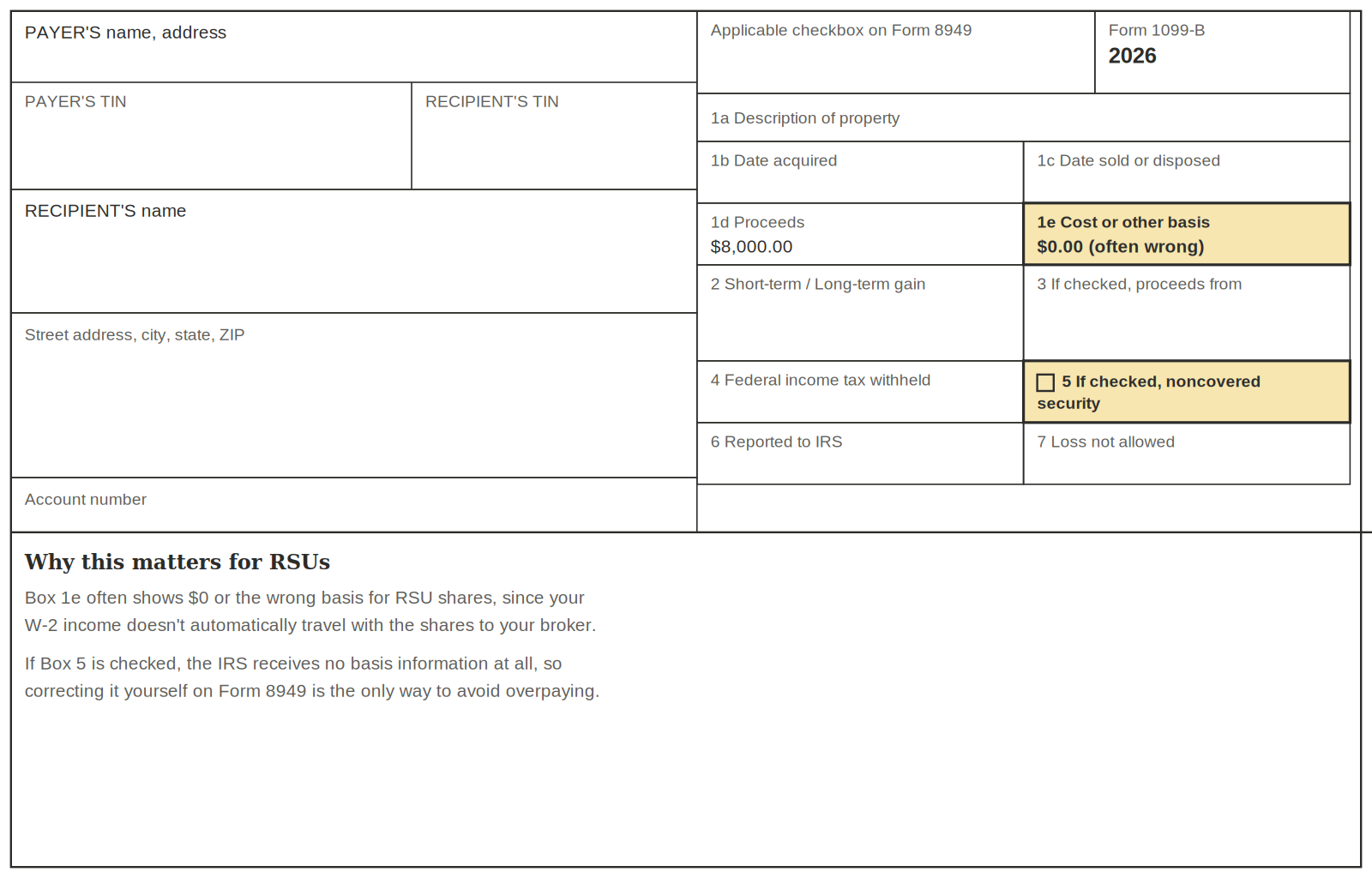
This usually happens because RSU shares often originate on an employer equity platform, like Schwab Equity Awards, Morgan Stanley at Work, or Fidelity NetBenefits. When shares are sold or transferred, the compensation income already captured on your W-2 doesn’t automatically travel with them to the brokerage’s records. The receiving broker sees shares arrive with no purchase price on file, so it reports a cost basis of $0, or leaves it blank.
If you enter that number as-is on your tax return, you’ll pay tax on the full sale price as a gain, even though you already paid tax on most of that value when the shares vested. That’s the double taxation problem, and it’s the single most common RSU tax mistake.
🔑 KEY CONCEPT
Your cost basis for RSU shares is the fair market value on the vesting date, not $0 and not the grant price. Your W-2 already includes that value as income, so your cost basis needs to reflect it too, or you’ll be taxed on it twice.
Where Each Number Actually Comes From
Three documents matter here, and each one tells a different part of the story. Your W-2 shows the total vested value as ordinary income for the year, already included in your wages. Your 1099-B shows the proceeds from any shares you sold, along with whatever cost basis your brokerage reported. Your supplemental stock plan documents (usually available through your equity platform, not your regular paystub) show the actual vesting dates, share counts, and fair market values you need to correct the basis.
Compare all three before you file. If the 1099-B basis doesn’t match the fair market value at vesting, you’ll need to make an adjustment on Form 8949 when you report the sale.
⚠️ WATCH OUT FOR
Don’t assume your tax software pulls the correct basis automatically just because it imports your 1099-B. Also check Box 5. If it marks your shares as “non-covered,” the IRS receives no basis information at all, and correcting it against your vesting records is entirely on you.
Who Runs Into This Most Often
People who sell RSU shares soon after vesting are especially exposed to this error, since a same-day or near-immediate sale often shows almost no reported gain if the basis is correct, but a large phantom gain if it isn’t. Employees at companies with frequent vesting schedules face it repeatedly throughout the year, since every sale creates another 1099-B with the same basis risk. And anyone using tax software without manually reviewing imported numbers is likely to carry the error straight through to their filed return.
Tax treatment varies by individual circumstances, filing status, and state of residence; the examples below are illustrative. Work with a tax advisor to review your specific situation.
A Few Examples
Example 1: A single vest. Say 50 shares vest at $100 each. Your W-2 already includes $5,000 of income for that vest. If you sell those shares the same day at $100, your correct cost basis is $5,000, meaning your capital gain is $0. But if your 1099-B lists a $0 basis, your tax software might report a $5,000 gain that doesn’t actually exist.
Example 2: Holding after vesting. Now imagine you hold those shares for six months and sell at $120. Your correct basis is still $5,000, the value at vesting, so your taxable gain is $1,000, the appreciation since vesting, not the full $6,000 sale price.
Example 3: Multiple vesting dates. Picture selling shares from three separate vesting dates in one year. Each batch has its own fair market value at vesting, so each sale needs its own corrected basis. Lumping them together, or using one flat number for all three, is a common way this error compounds.
What Should You Do About It?
- Pull your supplemental stock plan statement. This document, usually from your equity platform, lists the actual fair market value at each vesting date.
- Compare it against your 1099-B. If the basis doesn’t match, you’ll need to adjust it before it flows to Schedule D.
- Use Form 8949 to correct it. For most RSU sales (covered shares), enter the 1099-B’s reported basis in Column (e) – even if it’s $0 – then enter Code B in Column (f) and your basis adjustment as a negative number in Column (g). The corrected gain flows to Schedule D. If your shares are noncovered (Box 5 is checked), you can enter the correct basis directly in Column (e)
- Don’t skip this step even if you use tax software. Review every imported number rather than assuming the software corrected it for you.
- Keep your vesting records organized year over year. Multiple vests across multiple years make this harder to reconstruct later if you don’t track it as you go.
- Loop in a tax professional if you sold shares from several vesting dates. The more sales in a year, the more room there is for a basis mismatch to slip through.
💡 VALORIA PERSPECTIVE
I’ve seen clients pay thousands in tax they didn’t actually owe, simply because a brokerage form listed the wrong basis and nobody caught it. This isn’t a rare glitch. It’s a structural quirk in how these forms get generated, and checking it takes minutes once you know what to look for.
Common Questions
What is a 1099-B and why does it matter for RSUs?
It’s the tax form your brokerage sends reporting any shares you sold during the year. For RSUs, it often understates your true cost basis, which is why it needs a second look before filing.
Do I need to report RSU income if I never sold any shares?
Yes. Vesting itself creates taxable income, reported on your W-2 and included in your regular tax filing. No separate form is needed just for the vest itself.
What happens if I don’t correct the cost basis?
You’ll likely overpay, since you’ll be taxed on income you already paid tax on through your W-2. The IRS won’t catch this for you; the error works in their favor, not yours.
Where do I find the correct fair market value at vesting?
Check your equity platform’s supplemental stock plan statement, or your year-end RSU tax summary if your employer provides one.
Does this apply to shares from an ESPP too?
ESPP shares have their own basis rules, related but different from RSU vesting. Treat them as a separate reporting step rather than assuming the same math applies.
Can I fix a prior year return if I already overpaid?
In many cases, yes, through an amended return. Talk to a tax professional about whether filing Form 1040-X makes sense for your situation.
For the bigger picture on how RSU taxation fits into your overall plan, visit my About page or explore the full Equity Compensation guide.
Worried you’re overpaying on your RSU taxes?
I help women in tech build a clear, confident plan around their equity compensation.
Schedule a Call